RAF F-35B Lightning II - Why, How And When It Dispatches Flares As A Deterrent
- Start Aviation

- Nov 9, 2025
- 5 min read
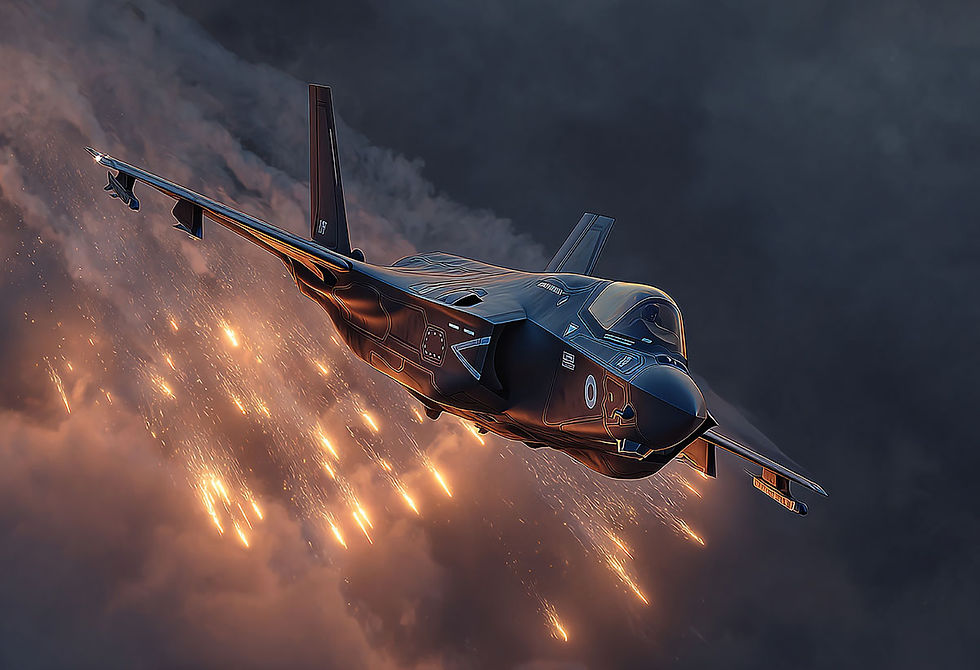
When Britain’s F-35B Lightning II streaks into view - low, lean and stealthy - you might sometimes see a bright handful of pyrotechnic flares ejecting from the aircraft. Those streaks aren’t for show: they are one element of a layered defensive system designed to protect the jet and its pilot from heat-seeking threats, and in some situations they act as an immediate deterrent to hostile systems. This post explains what those flares are, how they fit into the F-35’s broader defensive toolbox, why crews use them as a deterrent, and what safety, legal and operational considerations surround their use.

What Are Flares (In Plain Terms)
Flares are expendable pyrotechnic countermeasures that burn hot and produce strong infrared (IR) signatures. Heat-seeking missiles lock onto the IR emissions of an aircraft’s engine; by throwing off intense alternate heat sources, flares aim to lure the missile away from the aircraft. In practical terms, a flare is an emergency decoy - a short-lived, bright heat source designed to confuse an incoming seeker long enough for the aircraft to escape or for other defences to intervene.
F-35s (including the UK’s F-35B) carry both integrated electronic-warfare sensors and traditional expendable countermeasures - so flares are one part of that protective mix.
How The F-35’s Defensive Suite Works
The F-35 is a fifth-generation platform built around sensor fusion and stealth, but it still uses conventional countermeasures when needed. Its defensive approach typically layers:
Stealth and tactics: minimise detection in the first place (low observability, careful routing, electronic support).
Passive and active sensors: detect and classify threats - radar warning, missile-approach sensors and IR detectors feed information to the pilot and defensive systems.
Electronic warfare (EW): jamming, deception and other RF/IR techniques can degrade or confuse an attacker’s detection and targeting chain. The F-35’s AN/ASQ-239 EW system is a core component of this capability.
Expendable countermeasures: chaff and flares - physical decoys that create false radar or heat signatures to lure away radar-guided or IR-guided weapons. Photographs and close-up reporting show that F-35s have internal dispensers and hatches from which countermeasures are deployed.
Crucially, these layers work together: flares on their own are less effective against modern multi-mode seekers, but combined with EW and tactical manoeuvres they remain a valuable last line of defence.

Flares As A Deterrent - What That Looks Like
When we say flares can act as a deterrent, we mean two related things:
Immediate, visible response to a threat - releasing flares signals that the aircraft is actively defending itself. For a missile operator or an adversary considering engagement, that visible defence can dissuade further action (for example, if the attacker realises their missile lock has been broken or the engagement will cost them missiles or expose their position).
Tactical effect on sensors and human decision-making - even if a flare does not guarantee the missile will miss, the presence of countermeasures complicates the attacker’s calculus. Ground operators of man-portable air-defence systems (MANPADS), air defence crews and opposing pilots must decide whether to continue an engagement against a defended target. The complexity and risk introduced by flares (and other countermeasures) can act as an operational deterrent.
Put simply: flares aren’t just physical decoys - they are a message that the aircraft has defensive depth and is prepared to survive, which can be enough to persuade some adversaries to disengage.

When The RAF Would Use Flares
The RAF’s doctrine and pilot training emphasise layered protection and risk-based decision-making. Typical scenarios where flares might be used include:
When a heat-seeking missile launch is detected or a missile approach warning activates.
In hostile environments where MANPADS or IR-guided systems are known or suspected to be present.
During forced-evade manoeuvres where the aircraft needs an immediate physical countermeasure to maximise survival probability.
Operational commanders and crews choose countermeasure employment based on threat type, rules of engagement and environmental safety. The F-35’s onboard sensors and EW play a central role in that decision loop, cueing the pilot or automated systems to deploy flares if appropriate.

Safety, Environmental And Public Considerations
Flares are pyrotechnic and can pose hazards - especially over land:
Fire risk: in dry conditions, falling pyrotechnic material can start fires. Military planners and aircrew must consider terrain, population and fire seasons before employing flares in peacetime or near populated areas.
Debris and impact: spent cartridges or unburned material can fall into populated or sensitive areas; training and live operations account for this risk.
Public perception: a burst of flares over a civilian area can alarm people. Armed forces typically publicise exercises and manage airspace to avoid unnecessary concern.
Because of these factors, peacetime displays or training that involve flares are carefully controlled and notified to relevant authorities. The use of flares in combat is governed by operational necessity and the rules that apply in that theatre of operations.

Training, Testing And Rules Of Engagement
RAF F-35 crews undergo rigorous training - not only in flying and tactics but in threat recognition and defensive employment. That training includes simulated missile engagements, EW drills and familiarisation with how expendables behave in different conditions. Beyond the tactical training, there are higher-level rules of engagement and legal considerations governing when and where countermeasures can be used.
The UK’s F-35 fleet has also been subject to formal reviews and capability assessments (programmatic and operational), and the aircraft fleet’s defensive suites are continually updated and integrated with allied assets. Public sources from the RAF and industry document the F-35’s layered defence approach and ongoing capability work.

Photo-Opportunities And Capturing Flares Safely
For photographers - yes, those moments when an F-35 dispenses flares can make dramatic imagery - but remember:
Keep a safe, authorised vantage point and follow any range or airshow restrictions.
Use appropriate shutter speeds to capture streaks without overexposure; long exposures can create beautiful flare trails but may lose aircraft detail.
Respect operational security and do not attempt to position yourself in restricted or hazardous zones.
The RAF and supporting organisations often publish imagery and footage of flares in controlled contexts; those sources are excellent references for composition and safety best practice.

Myths And Realities
Myth: “Flares always make incoming missiles miss.” Reality: flares are effective against many IR seekers but not foolproof, especially against advanced multi-spectral or imaging seekers. Their effectiveness increases when used together with EW and manoeuvre.
Myth: “Flares are the only defence.” Reality: they are one tool among many - stealth, EW, chaff, decoys and tactics matter as much or more in modern air combat.

Final Thoughts
Seeing an RAF F-35B dispatch flares is a striking reminder that even the stealthiest, most advanced aircraft still rely on a pragmatic mixture of technology and time-tested countermeasures. In operational terms flares are both a physical decoy and a psychological/tactical deterrent - a short, bright message that the jet is defended and prepared to survive. For photographers and enthusiasts, they produce dramatic imagery; for commanders and pilots, they are part of a considered risk-mitigation toolbox governed by doctrine, training and safety obligations.
All images and more can be purchased HERE

Comments